On this page
Hailbell is our product, so weigh this with that in mind. Braze is a customer engagement platform built mainly for large consumer brands, and it does far more marketing than we do. For a team that needs push and a way for users to write back, that is more than the job needs. Braze facts come from braze.com/pricing and the Braze documentation, checked November 25, 2026. Prices are in US dollars.
At a glance
| Hailbell | Braze | |
|---|---|---|
| Built for | Apps and websites that want push and a support chat in one SDK | Built mainly for large consumer brands with marketing and CRM teams; a Go edition for early-stage growth teams |
| Channels you send on | Push (APNs, FCM, Web Push) | Push, web push, in-app messages, Banners, Content Cards, email, SMS, MMS, RCS, WhatsApp, KakaoTalk, LINE, webhooks |
| Support chat | Native chat on iOS and Android, plus a web widget, with AI first replies and your team in the same thread | None inside iOS or Android apps; Conversational Agents (beta) puts an AI agent on SMS, RCS, WhatsApp and a web chat widget; human chat comes from partners such as Zendesk Chat, Front or Sendbird |
| AI replies to customers | Included on every plan; answers from your notes, prices and help articles | Conversational Agents (beta): an AI agent that completes tasks you define |
| Where your team answers customers | Dashboard, a Discord or Slack thread per customer, or your own Telegram bot | No team inbox in its docs; Conversational Agents keeps a conversation history to review |
| Offers and review requests in a chat | Cards that open your paywall or the store review page | Not in its docs |
| Store reviews | New App Store and Google Play reviews in Slack, Discord, Telegram and the dashboard; a reply typed there is published on the store | Not found in its docs |
| SDKs | Native Swift (iOS 16+) and Kotlin (Android 8+); Flutter and React Native packages wrap them; web | Swift, Android, Web, Flutter, React Native (with an Expo plugin), Cordova, Unity, .NET MAUI, Fire OS, Roku and TV |
| Local-time sends | Each person's local clock time, or the hour they usually use the app; every plan | Local time zone delivery, and Intelligent Timing at each user's predicted best time |
| Caps and quiet hours | Daily and weekly promotional caps per person across platforms, and quiet hours; every plan | Up to 10 frequency capping rules per workspace, per channel or tag, with windows from minutes to 30 days; quiet hours in each user's local time |
| Automated flows | Three ready-made ones: a push after someone closes the paywall without buying, a chat message when a renewal fails, and a chat message asking why when someone cancels; no flow builder | Canvas journey builder across every channel |
| Agents over MCP | Every plan: push, segments, AI settings, and reading and answering chats | Remote MCP server with read and write tools for campaigns, segments and templates; Canvas tools read-only; no user profile data |
| Price | $29/mo for 10,000 monthly active users; $79/mo for 100,000; $299/mo for 500,000; Enterprise from $599/mo | Not published; a contract priced by monthly active users, profiles and Action Credits |
| How you start | Sign up yourself; 14-day trial, no card | A free trial ("Try Braze free for 14 days") or a sales call; no free plan |
What it costs
Braze doesn't put a number on its site. Its pricing page says "Pricing scales with your Monthly Active Users (MAU)", and a contract is built from four parts: a Platform Edition (Go, Select, Pro or Enterprise), your monthly active users and profiles, an allotment of Action Credits, and services. Braze Go is sold to early-stage growth teams, but it is still a contract with no public price and no free plan. Credits pay for sends on some channels; its FAQ gives the example that an SMS may cost 1 credit and a WhatsApp message 5. The same FAQ says "Braze does not offer a free plan at this time", and points to trials, startup programs and other entry plans instead.
So the real price comes from a sales conversation. For a sense of scale, one Hacker News commenter wrote in 2024 that "Braze's starter plan is close to $35k/year". That is one person's claim, not a price list, and your quote will depend on your users and channels.
| Monthly active users | Hailbell | Braze |
|---|---|---|
| Up to 10,000 | $29/mo (Pro), $290/yr | Quote |
| Up to 100,000 | $79/mo (Scale), $790/yr | Quote |
| Up to 500,000 | $299/mo (Business), $2,990/yr | Quote |
| More than 500,000 | Enterprise, from $599/mo on a yearly contract | Quote |
Prices checked November 25, 2026, on braze.com/pricing and hailbell.com.
Every Hailbell plan has chat, push and AI replies on iOS, Android and web, with unlimited apps and seats, which matters if you're an agency with several client apps. A paid plan keeps working if you go over; after two months over the limit you move to the plan that fits at your next renewal. The 14-day money-back guarantee refunds your first payment in full if you ask within 14 days of it, as long as AI replies used under 20% of the plan's monthly AI allowance.
Push side by side
Both send through APNs, FCM and Web Push, with segments and scheduling. Braze wraps push in a much larger campaign tool.
Timing. Braze can deliver in each user's local time zone, and its Intelligent Timing sends each message when Braze predicts that user is most likely to engage. Its docs say to launch an Intelligent Timing campaign at least 25 hours before the send date, and delivery runs for about 48 hours as the day passes through every time zone. Hailbell does a clock time in each person's time zone, or the hour that person usually opens the app, with a fallback time for people without enough history, on every plan.
Limits. Braze has more knobs. You set up to 10 frequency capping rules per workspace, per channel or per tag, with windows from minutes to 30 days, and the strictest rule wins. Quiet hours are set in each user's local time, and you choose whether a message that lands in them waits until they end or is dropped. Hailbell has a daily and a weekly cap per person for promotional pushes, such as 1 a day and 3 a week. Each is counted across iOS, Android and web, so pushes on a second platform can't take a person past the cap. Promotional pushes also wait out quiet hours in each device's time zone.
Content and flows. Braze's Canvas builds multi-step journeys across push, email, SMS and in-app messages, with BrazeAI copy and A/B tests. A Hailbell campaign can carry 2 to 5 versions, and each person gets the one their own taps say they like, with variables like {{first_name|there}}, {{city}} and the local weather. Instead of a journey builder, Hailbell has three automatic messages: a push a day after your app reports a paywall close without a purchase (Hailbell.track("paywall_decline")), a chat message when a renewal fails, and a chat message asking why when someone cancels. Not sure you need a platform this size? Read do you need more than Firebase Cloud Messaging.
Where Hailbell is better
- People can write back. Someone taps a push and has a question. Hailbell's native support chat sits in the same SDK, plus a web widget for websites and web apps. The AI answers first, and you finish from the dashboard, a Discord or Slack thread per customer or your own Telegram bot. Braze has no in-app chat on iOS or Android, and its docs show no inbox where your team replies.
- The chat knows what they paid. Each conversation shows plan, status and total spent from Superwall or RevenueCat on apps, or Stripe, Dodo Payments or Polar on websites, plus paywall closes your app reports. Offer cards open your paywall, and review cards open the store review page.
- A price you can read, and no sales call. $29, $79 or $299 a month, on the site, with unlimited apps and seats, and no yearly contract below Enterprise. Braze needs a sales conversation to get a number.
- Store reviews and support email in the same place. New App Store and Google Play reviews arrive in Slack, Discord, Telegram and the dashboard, and a reply typed there is published on the store. Your support email lands in the same inbox as the chats.
Where Braze is better
- Every marketing channel. Email, SMS, MMS, RCS, WhatsApp, KakaoTalk and LINE, plus audience sync to ad networks, all in one Canvas journey. Hailbell's campaigns are push only, and it has three fixed automatic messages.
- In-app messages, Banners and Content Cards. Braze can put a campaign inside the app without a push. Hailbell has none of these; it shows offers and review requests as cards in the support chat.
- AI agents on messaging channels. Conversational Agents, in beta, let people talk with an AI agent over SMS, RCS, WhatsApp or a web chat widget to finish tasks you define. Hailbell's AI answers in its own chat and in support email forwarded to it, not over SMS, RCS or WhatsApp.
- More platforms. Huawei push, Live Activities on iOS, and SDKs for Unity, Cordova, .NET MAUI, Fire OS, Roku and TV. Hailbell's Android push runs through FCM only.
- Predictive AI and experiments. Intelligent Timing, predictive features, and A/B tests where BrazeAI sends an initial test and then the best-performing variant to the rest of the audience.
- Security paperwork. Braze's docs list ISO 27001, a SOC 2 Type 2 examination and a HIPAA cluster. If your procurement team needs those, Braze has them and Hailbell doesn't.
For a large brand with a CRM team that already runs email and SMS at scale, Braze is the right tool. You could still add Hailbell for the support chat.
Support chat inside the app
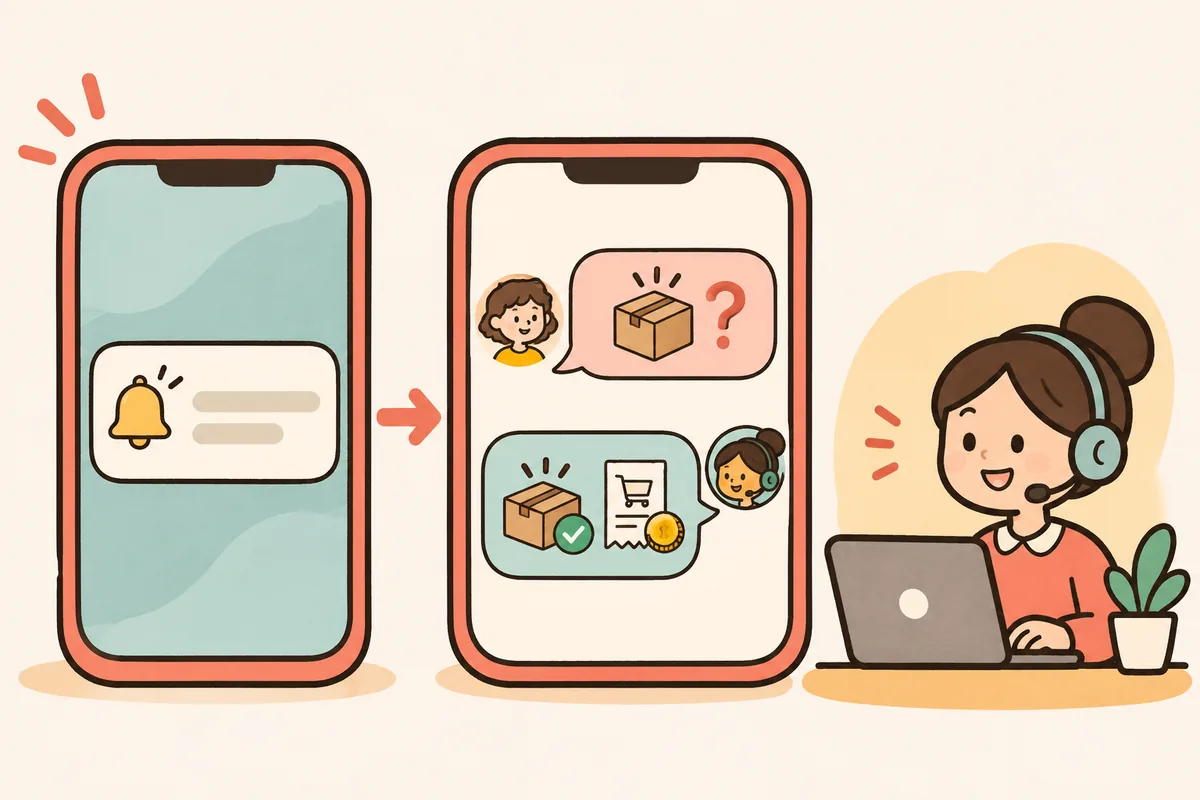
Someone comes back from a push with a question: "the trial didn't start", "I was charged twice", "is there a discount?". Braze's in-app messages can collect survey answers with its Simple Survey template, but they aren't a conversation your team replies in. Its Conversational Agents, in beta, put an AI agent on SMS, RCS, WhatsApp and a web chat widget, with no inbox for your team in its docs and nothing inside iOS or Android apps. For human chat, its partner directory lists tools such as Zendesk Chat, Front, Dixa and Sendbird, so that is a second product and usually a second SDK.
Hailbell puts a native support chat in the same SDK as push, in SwiftUI and Compose, plus a web widget. The AI answers first from your notes, prices and help articles, and tells users when an AI may answer. You finish the reply from the dashboard, a Discord or Slack thread per customer or your own Telegram bot, and the customer gets a push that opens the thread.
Each conversation shows the customer's plan and purchases, plus paywall closes your app reports. An offer card opens one of your paywalls, which is how you talk to the people who leave at the paywall instead of only pushing at them. Once a problem is solved, a review card opens the App Store review sheet, or your Play Store listing on Android.
Setup, SDKs and working from an AI agent
On either service, push permission belongs to your app, so once a new version calls the new SDK's push setup at launch, devices that already allowed notifications register with no new prompt. Hailbell has no import from Braze or any other tool, so rebuild your segments and expect people who never update to drop off.
Both have a REST API and an MCP server an agent like Claude Code or Codex can use. Braze's remote MCP server has read and write tools for campaigns, segments, tags and templates; its Canvas tools are read-only, and it returns no data from user profiles. Hailbell's MCP server previews and sends push, and any broadcast needs a preview first, so nothing goes to everyone by accident. It also reads and answers support chats with each customer's plan and purchases; those replies wait as drafts for a teammate unless an admin lets agents send.
How to choose
- For most apps and websites: Hailbell. Push at each person's local time or usual hour, with caps and quiet hours, plus a support chat with AI first replies, for $29 or $79 a month across all your apps.
- You're an agency with several client apps, or you sell subscriptions and want follow-ups after a paywall close, a failed renewal or a cancel: Hailbell.
- You run email, SMS and WhatsApp journeys with a CRM team, ship to Huawei, Roku or TV, or need ISO 27001 and SOC 2 reports: Braze.
Try Hailbell free for 14 days or read the docs. Comparing more push tools? See the best push notification service for small apps and Hailbell vs OneSignal.
Questions
Is Hailbell better than Braze?
For most apps and websites that want push plus a support chat, yes. Hailbell's push has local-time sends, quiet hours and caps, and the same SDK has a support chat where the AI answers first and you see what each customer bought, for $29 a month at 10,000 monthly active users. Pick Braze instead if you need a journey builder, email, SMS or WhatsApp journeys, AI agent chats over SMS, RCS or WhatsApp (in beta), audience sync to ad networks, in-app messages, Banners and Content Cards, Huawei push or Live Activities, SDKs for Unity, Cordova, .NET MAUI, Fire OS, Roku or TV, predictive AI, A/B tests where BrazeAI sends the best-performing variant, frequency caps per channel or tag, or security certifications for a procurement review.
How much does Braze cost?
Braze doesn't publish prices. A contract combines a Platform Edition, monthly active users and profiles, Action Credits and services, and its sales team sets the number. There is no free plan, but there is a free trial. Hailbell is $29, $79 or $299 a month for up to 10,000, 100,000 or 500,000 monthly active users. Checked November 25, 2026.
Does Braze have in-app support chat?
Not inside iOS or Android apps. Its Conversational Agents, in beta, let users talk with an AI agent over SMS, RCS, WhatsApp and a web chat widget, and its docs describe no team inbox where staff reply. For human support chat, its partner directory lists tools such as Zendesk Chat, Front, Dixa and Sendbird. Hailbell's SDK has a native support chat next to push, and your team answers in the same place.
Questions about Hailbell vs Braze for your app? Start a chat with us. It runs on Hailbell, so you see the product while you ask.

Vidur Saini
Vidur is the founder of Hailbell, in-app support chat and push notifications for iOS, Android and web apps. Questions about this article? Write to hello@hailbell.com or @vidursaini on X.